What the routine is
Cornflakes is the first of the two routines Milk Boy performed in the final of the M-1 Grand Prix 2019 (competition history, in Japanese) — “an annual Manzai competition planned by Shinsuke Shimada and run by Yoshimoto Kogyo” (M-1 Grand Prix, Wikipedia). Manzai is the two-person stage form the competition exists for; its working vocabulary — boke, tsukkomi, furi, ochi — is set out on the pattern index.
The routine scored 681 points. That is the highest score in the history of the competition’s seven-judge era, and English Wikipedia records it as beating Untouchable’s previous record of 673. Milk Boy were appearing in the final for the first time, and went on to win the whole thing (ORICON NEWS, in Japanese).
The score broke down like this.
| Judge | Score |
|---|---|
| Nobuyuki Hanawa (Knights) | 99 |
| Emiko Kaminuma | 98 |
| All Kyojin | 97 |
| Shiraku Tatekawa | 97 |
| Takeshi Tomizawa (Sandwich Man) | 97 |
| Hitoshi Matsumoto | 97 |
| Reiji (Nakagawake) | 96 |
(Scores from M-1 Grand Prix 2019, Wikipedia, in Japanese; the judges’ names are romanized as on the English M-1 article.)
The routine that won the final round itself was a different one, Monaka. This article deals only with the first routine.
The frame, not the contents
What follows is not about what the routine says. It is about the container the material is loaded into.
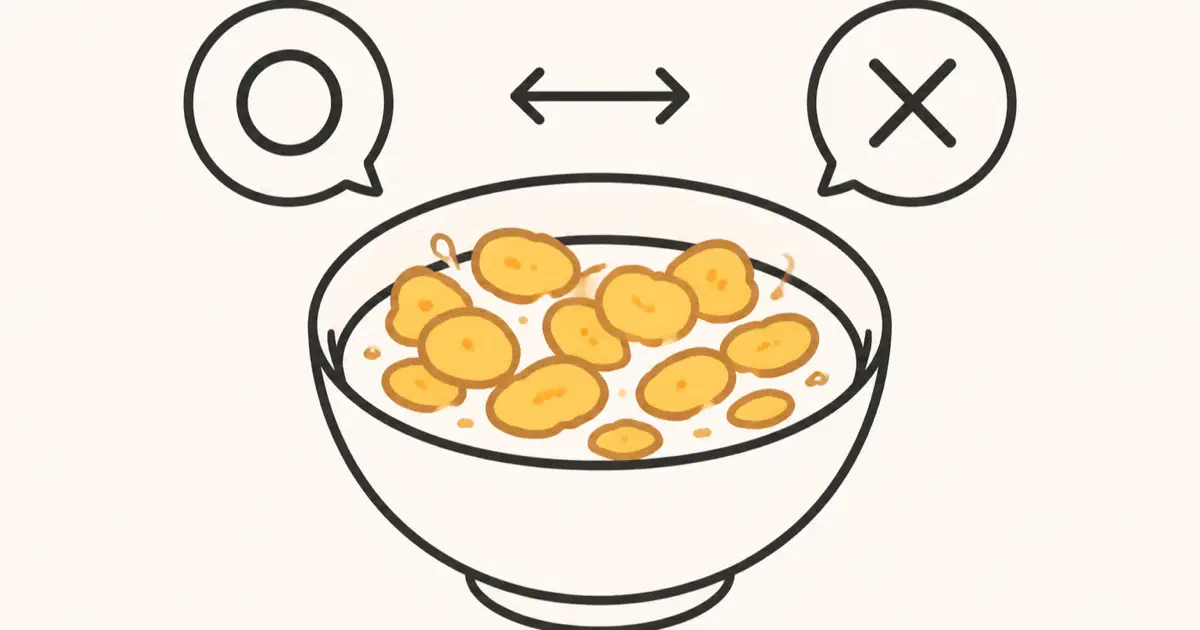
One unidentified thing is set up, and only one. It takes the form of a breakfast the boke’s mother likes, whose name she has forgotten. Everything afterwards flows toward that single point.
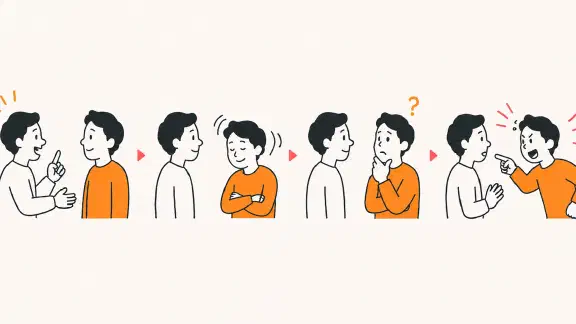
Then one round trip is repeated, and repeated. A feature is offered → a verdict is declared → counter-evidence arrives → the verdict is withdrawn. That single round trip keeps the same shape until the end. The contents swap out every time. The container never changes once.
The distance between furi and ochi is compressed to its limit. Ordinary manzai stacks setup and drops it at the end — one large hill. This routine does not build the hill. An ochi lands once per round trip. The grain — kizami — is extremely fine.
The first two or three round trips teach the audience the frame. Once you have the shape, you no longer have to work out what is happening; you only have to watch which way each round trip falls. The cognitive load drops, and the laugh gets off the ground faster.
No hill — a pulse held at one amplitude. It stays level to the end. Repetition is normally what makes an audience tire; here it has been converted into the weapon.
Which pattern is inside
Exactly one of the nineteen comedy design patterns is running in that frame.
Aruaru, the recognition list. The features being offered function directly as cornflakes aruaru. Each one is a property the audience already owns, so the laugh is recognition rather than surprise — and, as the aruaru article puts it, the room’s response is doing double duty as verification: yes, that is true of the thing.
Pulling out a catalogue of nineteen patterns and coming back with one match may look like a thin result.
The interesting part is on the other side of it. This routine lets you name, precisely, three patterns that do not apply — and one of those three looks like a match purely because its name sounds like one. The next section takes them in order.
Where no pattern fits
There are two such places: how the repetition is done, and how the counter-evidence is used.
Point A: this repetition is neither of the two repetition patterns
The catalogue has two patterns of repetition. The repetition described above — the same frame, struck over and over — is neither of them.
It is not tendon. Tendon brings the same joke back after leaving a gap, and the gap is the thing being designed. Cornflakes leaves no gap at all. And what returns is not the same joke; it is the same frame, with different contents inside it every time.
It is not escalate, either. Escalate raises the magnitude on every pass, and the increase is itself the joke (summarized on the pattern index; its own English article is still to come). Cornflakes does not raise anything. The amplitude is flat from start to finish.
What is left is this:
Fix the frame, swap only the contents on every pass, and hold the amplitude constant.
Tendon varies the interval. Escalate varies the magnitude. This varies neither. The only thing in motion is what gets loaded into the container — and the two repetition patterns in the catalogue cannot account for that shape.
So this article will provisionally call it fixed-frame repetition (型反復, kata-hanpuku).
Handle that name with care.
- It is a name this site has put down provisionally. It is a working label, not a settled one.
- It has not been checked against existing Japanese performance vocabulary. There may well already be a term for this structure under a different name. Do not take it as standard industry terminology.
- If the same structure turns up in other routines, it will be promoted to a pattern of its own at that point. Erecting a pattern on the evidence of a single routine is premature for a catalogue.
Point B: the counter-evidence is not nai-nai
The second place is the counter-evidence that arrives in the back half of each round trip.
It looks like nai-nai — two genuine aruaru to earn agreement, then a third that could not possibly have happened (summarized on the pattern index; its own English article is still to come). The word nai — “there isn’t” — is in the pattern’s name, and negation is exactly what the counter-evidence does, so the match seems obvious. It does not hold.
Put the definition and the success conditions side by side:
| Nai-nai, as this site defines it | The counter-evidence in Cornflakes | |
|---|---|---|
| What it puts out | a non-existent exaggeration | an actual fact — a property the candidate does not have |
| How it is delivered | never flagged | presented explicitly, as counter-evidence |
| Structure | two aruaru plus a third that leaves the category — a three-beat drop | one affirmation and one negation, per round trip |
| Response aimed at | “no way — but I know exactly what you mean” | “no, that isn’t it” — a check |
The decisive row is the second one. The Japanese edition’s nai-nai article makes concealment a condition of the pattern: when the third item slides into the non-existent, the audience must not be told that it has. The moment the register swells, a sign has gone up reading the made-up part starts here — and the betrayal stops working.
The counter-evidence in Cornflakes does the opposite. It is not hidden. It is handed over, plainly, as counter-evidence, and the handing-over is itself part of the frame.
The shared word conceals two different operations. Patterns with similar-sounding names are exactly where matching on the title and the one-line summary causes accidents; the difference only became visible after going down to the definition and the success conditions.
So what is it? None of the nineteen patterns has a name for this use of counter-evidence.
Unlike Point A, no provisional name goes down here. The observation — no pattern covers it — is complete; the step after that, working out what the structure actually is, is not. Putting two provisional names into one article would make the catalogue cheaper, not richer. The name comes after the structure is visible.
Point A’s provisional label and Point B’s missing name will both be settled by stacking up more routines. This article is the first of them.
Where to watch it
The routine is included on the DVD 『M-1グランプリ2019〜史上最高681点の衝撃〜』 (M-1 Grand Prix 2019: The Shock of the Highest Score Ever, 681). Alongside the final and the repechage round, it carries a re-edited version of Another Story, which followed the competition behind the scenes, and new manzai from Milk Boy (Owarai Natalie, in Japanese).