What it is
Two words first, because everything here is built out of them. In Japanese comedy the boke is the one who says the wrong thing, and the tsukkomi is the one who corrects it — the word covers both the person and the act. In a two-person routine those are conventionally separate jobs, held by different people — acts that blur the two, or swap them mid-routine, do exist.
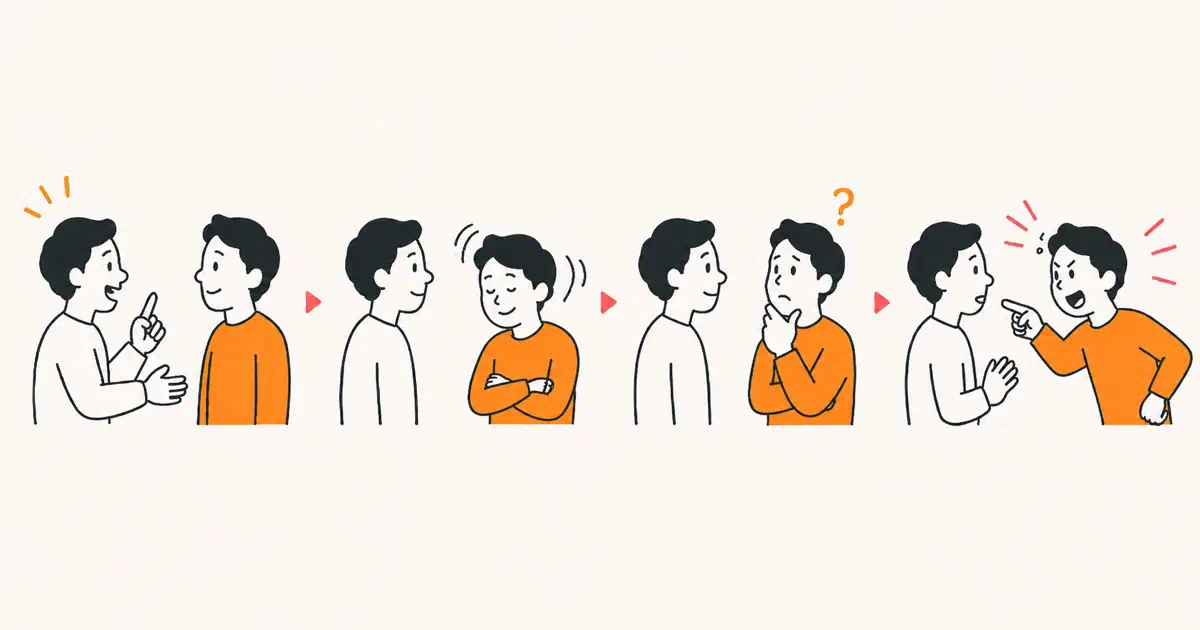
Noritsukkomi is the variant where the corrector, offered something obviously absurd, does not correct it. Not yet. They get on board — nori is “riding” — and travel with it for a moment as though it were a perfectly reasonable state of affairs. Then they stop, snap out of it, and reject it in their own voice.
The canonical shape, at a restaurant, when a friend who has ordered heavily stands up and says “thanks for the meal!”:
“Sure — you want dessert too? …Hang on, why am I the one paying?!”
Three moves, roughly three seconds: accept, go along with it, reject. The tsukkomi is still delivered — it is simply delivered late, and by someone who spent the interval acting as the boke’s accomplice.
Why it works
An immediate correction is clean but small. The premise is put up, knocked down, and everyone moves on.
Riding it first does something an immediate correction cannot: it creates a real moment of doubt. For a second the listener genuinely does not know what they are watching. Wait — did they just accept that? The floor they were standing on, the assumption that someone in this conversation is still tracking reality, quietly goes away.
That interval is the charge. And then the correction lands, and it lands on a room that had already begun to adjust to the absurd premise. The pattern is a hold and a betrayal stacked together, and the size of the payoff scales with how long the hold ran and how sincerely you sold it.
There is a second thing happening, which is why the pattern feels different from a straightforward correction even when the words are identical. By riding first, you spend a moment inside the absurd premise instead of standing outside it, and the correction arrives from someone who was, a second ago, a participant. Ordinary tsukkomi never leaves safe ground.
It is a genuinely advanced pattern
Of the nineteen, this is one of the few that requires actual technique, and the reason is timing — ma, the interval, the thing Japanese comedy treats as the primary craft variable. It is the same variable that tendon is built around, except that here the whole window is a few seconds wide rather than a few topics. There are two ways to miss, and they are on opposite sides:
- Break off too early and you have not built any doubt. The whole thing collapses into an ordinary tsukkomi with a strange preamble.
- Ride too long and you cannot get back. Past a certain point the exit stops being available; you are no longer a corrector who played along, you are simply the second boke, and there is nobody left in the conversation to close it.
The window between those two is narrower than it sounds when written down, and it is not learnable from a description. It is learnable by doing it and missing.
Closest English equivalent — and how it differs
This is one of the patterns here with no clean English counterpart. Not “the English term is slightly different” — there is no single move in English-language comedy that packages these components together and gets called something.
Three things sit nearby, and each one is missing a different piece.
The double act. English-language comedy has the straight man and the funny man, and it has had them for a century. But it holds them as two people. The straight man’s whole function is to stay outside the absurdity and represent the audience’s sanity, so the moment he joins in, the act has to reorganize around it. Noritsukkomi puts both jobs in one head and switches between them inside about three seconds, on purpose, as a single named move. Solo comedians who play both parts do exist — but the deliberate sequence of accept, commit, then reject, executed as a single unit, is rare enough in English that it has never needed a name.
Improv’s “yes, and.” This is the closest match for the first half, and it is a genuinely good match: accept the offer, build on it, do not block. But “yes, and” is a rule with a direction, and the direction is one-way. The whole discipline is constructed to keep you from ever saying no. Noritsukkomi is “yes, and — no.” The rejection that improv structurally forbids is the exact thing this pattern is for. If you took the first two seconds of a noritsukkomi to an improv class you would be doing it right; the third second is where you would be doing it wrong.
The delayed double take. Closest at the level of gesture — a beat of apparent acceptance, then the realization. The difference is what happens during the beat. In a double take the performer’s character has simply not registered the thing yet; the interval is empty, dramatically speaking, and the comedy is in the delay of perception. In noritsukkomi the interval is occupied: you are actively going along with the false premise, usually adding something inside it. You want dessert too? is not the absence of a reaction. It is a contribution to a world you are about to demolish. That is what makes the demolition worth watching.
So the reason the term is worth carrying over in Japanese is not linguistic pride. Translate it as “playing along” and you have named the setup and dropped the punchline; translate it as “calling it out” and you have named the punchline and dropped the setup. The word exists because the two halves are one move, and a language that has the word can ask a performer for it.
Examples from anime and Japanese TV
In manzai, this pattern is the tsukkomi temporarily defecting. The two-person form usually assigns one performer to keep reality in the room, so a tsukkomi who starts agreeing is breaking a structural promise the audience can feel — and the return, when it comes, is a restoration as much as a correction. This is why the move reads as more of an event on stage than on paper.
In anime, comedy built on boke and tsukkomi exchanges is everywhere, and this pattern appears in it regularly. The art frequently helps: the visual register can drop into an exaggerated, deformed style for a comic reaction, which makes a shift in stance legible in a single cut. That is a general convention of the medium for reactions of all kinds rather than a marker reserved for this pattern — but it does mean that if you are watching for the moment someone stops playing along, the drawing is often doing part of the work.
As a combined form, the correction does not have to point outward. A friend says “you’ve put on weight.” You reject it while riding it — “no chance, I’m exercising, I’m counting calories, there’s no way” — then: "…actually, let me check." You raise your phone camera, look at yourself, and say, quietly, "…it’s true." The ride is intact; what changed is the target. The line comes back at you rather than at the friend, which makes this a hybrid with jigyaku, the self-deprecating pattern. Worth knowing as a variant, because it is often the version that fits a real conversation better than the confrontational one.
On variety television, watch for a performer taking a colleague’s obviously false claim and staying with it one step longer than expected — supplying a detail, agreeing enthusiastically, extending the fiction — before cutting it off. That interval is the tell. Someone who is merely slow to react is doing nothing during it; someone doing noritsukkomi usually contributes something — a detail, an agreement, a next step — rather than merely pausing.
How to use it
Do not be afraid of the pause. The instinct under pressure is to get to the correction quickly, because the correction is the safe part. But the interval you are rushing through is the thing you are making. Hold it one beat longer than feels comfortable.
Signal the return clearly. Japanese has purpose-built handles for this — …tte, iya — words whose entire job is to mark the seam where you stop riding and start correcting. English equivalents exist and are worth choosing deliberately: hang on, wait, …no. The reason it matters is that the audience has to be able to tell an ending from an interruption. A blurry seam reads as you losing the thread rather than closing it.
Match the exit to the entry. Ride sincerely, correct sharply. If you play the acceptance with a visible wink, nothing was ever really accepted and the doubt never forms; if you correct half-heartedly, the premise is never actually rejected and the moment just fades out. The contrast between the two halves is where the volume comes from.
Learn plain tsukkomi first. This is a variant of a basic move, and it is difficult to run a variant of something you do not do at all. If correcting people is not already in your ordinary conversational range, this pattern will feel like it requires a personality transplant, because for you it does. Start by being someone who reacts, then add the delay.
And know the two neighbors. When you want the same job done in one shot with no ride time, the sibling pattern is tatoe-tsukkomi, the correction delivered as a distant simile. When the absurd premise is your own rather than someone else’s, that is self-tsukkomi — and that one is genuinely the easiest of the three to start with, because you supply both halves and a miss costs nothing. Both are summarized on the pattern index until their own English articles are written.