What it is
Oyakusoku — literally “the promise” — is the standard, well-worn development for a situation, carried out exactly as everyone expected. In Japanese it is also called beta: the stock version, the obvious one, the move you can see coming from a long way off.
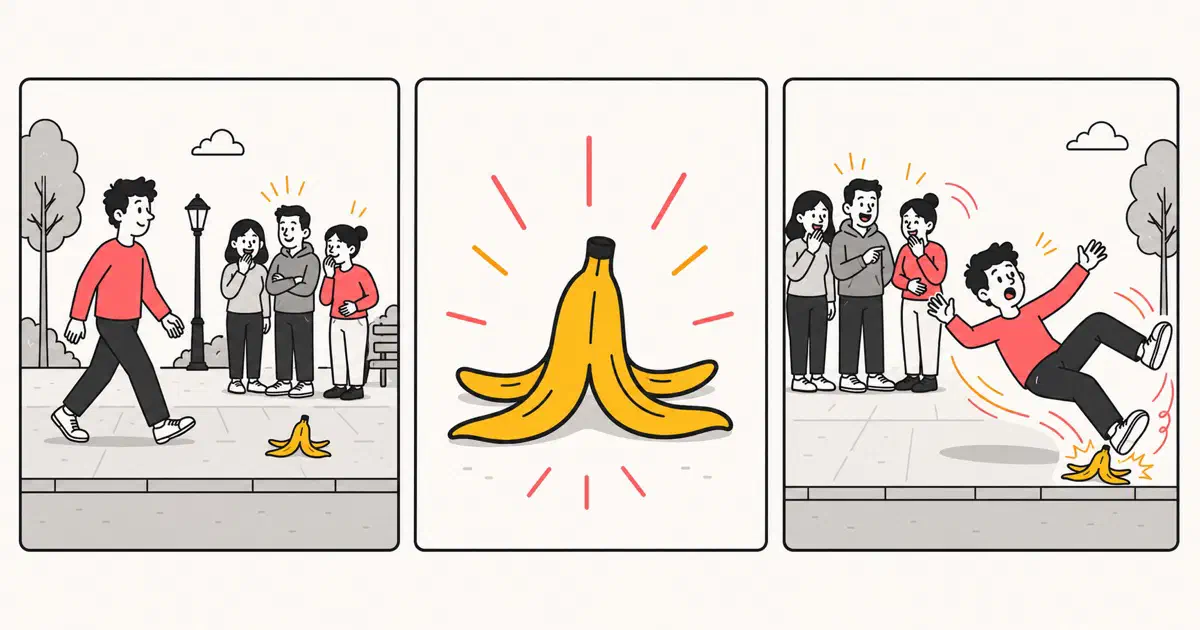
You are walking along and there is a banana peel on the ground. You do not step around it. You step squarely on it and go down.
That is the whole pattern. There is no twist, no inversion, nothing withheld. The situation announced what was supposed to happen next, and you did it, properly and without flinching.
For an English-speaking reader this is often the hardest of these patterns to accept, because in English comedy criticism “predictable” is close to a synonym for “failed.” Here it is the specification.
Why it works
Most comedy patterns run on the shape setup → payoff with a drop between them: an expectation is built and then something arrives that does not match it, and the mismatch is the laugh.
Oyakusoku runs on a different circuit. The setup builds an expectation — this is going to end the obvious way, isn’t it? — and then the ending is the obvious way. What is produced is not surprise. It is two other things at once: the reassurance of a thing completing exactly as promised, and the small private satisfaction of having called it correctly. You knew. You were right. And the room was right along with you, all at the same instant.
The strength of the pattern is set by how widely the script is shared
This is the load-bearing condition, and it is what makes oyakusoku fragile in a way the other patterns are not.
Its power depends entirely on whether everyone present is holding the same script. When they are, the anticipation lines up — here it comes — and the relief of completion fires across the whole room simultaneously. When someone in the room does not know the script, they do not get a weaker version of the joke. They get no joke at all, only a person falling over, and the visible question why is everybody laughing at that?
So this pattern is at its most powerful inside a group with a common foundation — a circle of friends with shared history, a fandom, an audience that has watched the same things — and at its weakest with anyone who never received the script. Before using it, the question to ask is not “is this funny?” but “does everyone here already know how this ends?”
The strongest form: “whatever you do, do not do this”
The most reliable version of oyakusoku is the emphatic prohibition. Someone stands at the edge of the thing they obviously must not fall into and says, with total seriousness, absolutely do not push me.
The prohibition is not a prohibition. Everybody in the room, including the person saying it, understands it as an instruction — and everybody knows that everybody understands it. That mutual knowledge is what turns the moment into the purest possible setup, and the laugh arrives when it is carried out precisely as forbidden. Note what the pattern asks of the second party: not cleverness, but the discipline to do the obvious thing on cue, straight-faced, exactly as ordered.
And note that it fails completely for a listener who does not hold the inverted reading. To them, someone said “don’t” and someone else did it anyway. The entire mechanism is the shared understanding, not the words.
Closest English equivalent — and how it differs
Two English concepts sit near this one, and each is illuminating for a different reason.
Genre convention, or “trope”
This is the closest match of the two, and structurally it is very nearly the same object: a stock situation a genre keeps returning to, which the audience recognizes on arrival.
The difference is one of stance. “Trope” is often neutral in fan usage — a name for a recognized move. “Cliché” is where the verdict lives, and in criticism the highest praise on offer is usually that a work subverted the expectation rather than that it completed one. Under oyakusoku, subversion is a different pattern entirely (sukashi — withholding the expected move, which is deliberately aimed at exactly this pattern because this pattern makes the next move so obvious; it is summarized on the pattern index until its own English article exists). The stock version is not the thing you rise above. It is the thing you execute cleanly, on purpose, for the specific pleasure that only a completed expectation can produce.
Put the difference at its sharpest: in English-language criticism the audience’s ability to see it coming is usually the problem; here it is the premise. Nothing about the pattern works if they cannot see it coming.
Running gag
Structurally further away — a running gag is repetition inside a single work, where oyakusoku is usually about a script shared across many works — but worth naming, because it is the association an English-speaking reader is most likely to bring here.
The useful observation is this: from the second or third repetition onward, a running gag is producing its laughs on the oyakusoku engine. The first instance can genuinely surprise. By the third, nobody is surprised; the audience is anticipating, recognizing the approach, and enjoying the arrival of exactly the thing they knew was coming. The pleasure has switched circuits from surprise to completion, which is the circuit described above. Tendon deliberately stops short of that switch: it fires once, on the strength of a single carefully sized gap, and gets out before repetition can turn into a shared script.
The difference that remains is where the script comes from. A running gag builds its own script inside one work, in front of you, over the course of it. Oyakusoku usually draws on a script the audience walked in already holding — which is why it can be delivered on first appearance, with no groundwork at all, and why it collapses so completely with an audience that was never issued it.
If you want the shortest useful summary for reading Japanese comedy: a running gag earns its expectation; oyakusoku inherits one.
Examples from anime and Japanese TV
In fiction, at the scale of a scene. The clearest case is the school-story sequence: a character runs out of the house late, with a slice of toast in their mouth, collides at the corner with — as the script specifies — someone their own age of the opposite sex, and then, at school, that same person is standing at the front of the classroom being introduced as the new transfer student.
Everything about that is known in advance. That is the point. Once the toast is in the mouth, the audience is not asking what happens next; they are watching to see it arrive, and the arrival is the satisfaction. Notice that this is a sequence, not a whole plot. Oyakusoku operates at whatever scale the shared script exists at — a single gesture, a beat, a full sequence like this one.
Comedy anime uses these openly and often works them as ingredients: the audience is assumed to be holding the script, which is exactly the condition the pattern needs.
In physical comedy. The banana peel above, and its close relative: someone approaches an obviously magnificent cake, trips, and goes in face-first. The full unit includes the beat of stillness before the cream-covered face comes back up. It shows up often in classic sketch material and in comedy performed by people who are not professional comedians — the kind of setting where the script is guaranteed to be shared, which is precisely where this pattern is strongest.
On variety television. The “absolutely do not push me” construction spread from a well-known variety routine and is now widely understood, and it is the clean demonstration of the shared-script principle: nothing is said out loud that means “push me,” and yet every viewer holds the same reading.
How to use it
Find the stock development and commit to it. The instinct trained by English-language comedy is to dodge the obvious ending. Here you take it head-on. Do not step around the peel.
Do the work in the setup, not the payoff. The ending is fixed and known, so nothing you do there can improve it. What decides whether the moment lands is how cleanly you laid the situation down beforehand — whether the room got a clear enough look to think ah, this is going to end the usual way. If the setup is muddy, there is nothing for the payoff to complete.
Check who is in the room first. This is the failure mode, and it is not a subtle one. The pattern’s yield is a direct function of shared knowledge. Among friends with a common history it is one of the most reliable things you can do; in front of an audience that does not hold the script, it produces silence and — worse — the impression that you thought that was enough.
Match the register the script specifies. Oyakusoku is an execution pattern rather than an invention pattern, so the craft is in fidelity: the pause before the face comes up, the deadpan of the prohibition, the fact that the fall is not hedged or half-committed. Playing it self-consciously — signaling that you know it is a cliché — cancels it. That signal converts the moment into commentary, and commentary does not complete anything.
Then know when to withhold it. Because this pattern makes the next move so obvious, it is the standard raw material for sukashi, the pattern of never delivering the expected reaction at all. That is the natural pairing: build the promise, and once in a while decline to keep it. But the withholding only means anything if the promise was real, which is to say — you have to be able to run this one straight before it is worth running it crooked.