What it is
Tendon is the pattern where a line or an event that landed once is brought back and delivered again — after leaving a gap.
The first delivery does not have to be funny. Its job is to put something in the room’s memory. The second delivery collects it. What produces the laugh is the sensation of return: oh — that again.
The gap is not a detail of execution. It is the pattern. A repetition with no gap is not a weak tendon; it is a different thing. Japanese craft vocabulary tends to file immediate piling-on under a different name — kabuse — a separate technique rather than a botched tendon. The full description of this pattern is not “say it twice.” It is “say it twice, with the right amount of time in between” — and the entire craft lives in that second clause.
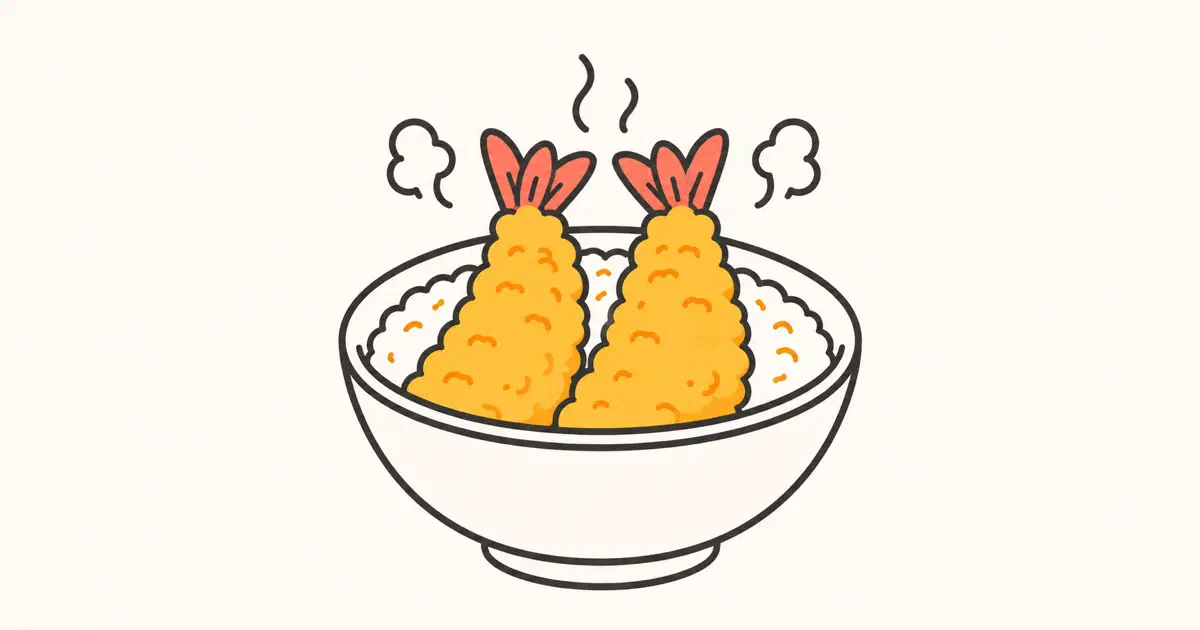
By one of several accounts, the name comes from the tendon, a bowl of rice topped with tempura, which carries two of the same shrimp. Two of the same thing, side by side.
What makes it one of the most practical patterns here is the cost. You do not have to invent anything. The material already exists, already worked once, and is sitting in everyone’s short-term memory waiting to be picked up.
Why it works
The pattern exploits a specific property of how people hold recent things.
A line that made an impression gets filed somewhere near the front of the mind. Then the conversation moves — a new topic, then another — and it slides back. It is not gone. It is half-forgotten: no longer active, still retrievable.
Drop the same line into that state and two reactions fire at the same moment. One is surprise — I did not expect that to come back. The other is recognition — that’s the thing from before. Surprising and already-known, simultaneously. That double signal is what snaps the tension and releases it, and neither half can be bought separately: new material cannot produce recognition, and material that is still fresh cannot produce surprise.
Which is why the timing is not a matter of taste.
The three intervals
Take one repeated line and change nothing about it — same words, same delivery — and vary only when you throw it. The result splits three ways.
- Too early — tiresome. The listener heard it moments ago and the memory is still fully active. There is no recognition to trigger, because nothing was forgotten. All that remains is the repetition itself, which reads as chanting, or as someone who liked their own joke a bit too much.
- Right — it lands. The listener has half-forgotten: roughly one or two topics downstream. Oh! They said that earlier! Rediscovery, which is the effect this pattern exists to produce.
- Too late — it does not register. The memory is gone. The line arrives as a strange non sequitur, and nobody identifies it as a return at all. It is not that the joke is weak; there is no joke, because nothing is being collected.
Same words in all three cases. The only variable is the interval. This is the sentence to take away from this article: the material is not what you are designing. The gap is.
That is also why it is worth treating “too early” as its own identifiable miss, rather than as simply doing the same thing more. In most descriptions of repetition-based humor, going sooner is only going more often; on the model above it is a distinct way of missing, with its own symptom.
Closest English equivalent — and how it differs
Two English concepts sit near this one. English-speaking readers usually arrive with the second, but the first is the closer match.
The stand-up callback
A comedian returns, late in a set, to a phrase or premise established much earlier, and the room lights up. The mechanism is the same one: recognition plus surprise, purchased with something the audience already owns.
The difference is what the terms describe. “Callback” names the return; tendon names the interval. A callback conventionally reaches a long way back — a tag on a bit from twenty minutes ago, sometimes from the top of the set — and its virtue is partly the sheer distance covered. Tendon is aimed at a much narrower and much more specific window: late enough that the room has stopped holding the line actively, early enough that the recognition still fires when it arrives.
You can hear part of the consequence in the vocabulary. Where a callback lands is certainly argued about in practice, but English has no settled term that names the tolerance — the window — rather than the move itself. The three-way split above is how this site models it: “too soon” is treated as a miss in its own right, on the same footing as “too late.”
The running gag
Structurally further away, but this is the association most English speakers bring — so it is worth being precise about what it does not cover.
A running gag is a repetition distributed across a whole work: the same joke reappearing across an episode, a season, a film. Its currency is accumulation. Each appearance is funnier partly because there have been so many, and the audience’s relationship is with the pattern of recurrence rather than with any one gap between two instances.
Tendon is not about accumulation and does not require a work to run inside. It is a two-instance structure, deployable in a conversation that will be over in ten minutes, and the thing under the comedian’s control is the single stretch of time between the two.
There is a real relationship, though, and it runs in the other direction from what you might expect. Once a running gag has recurred two or three times, the surprise component is gone, and the laughter has moved onto a different engine — the pleasure of a shared script completing as promised, which on this site is oyakusoku. Tendon deliberately stays on the near side of that transition. It fires once, on the strength of one carefully sized gap, and then gets out.
Examples from anime and Japanese TV
In anime, the version that matches this pattern is the line that comes back inside the same episode, after the story has moved somewhere else — a throwaway from the opening minutes reappearing once the scene, the location and the subject have all changed. The distance the episode travelled in between is exactly the gap this pattern is built around, and half-forgetting is precisely what the intervening story was doing to you.
Worth distinguishing from a character’s catchphrase, though. A signature line delivered in every episode across a whole series is not running on this mechanism, because nothing was ever half-forgotten. That is running-gag territory, and by then the audience is enjoying the arrival of something it was already expecting — a different pattern with a different engine.
On variety and talk television, the shape to watch for is a phrase that got a reaction early in a recording resurfacing a segment or two later, usually in a completely unrelated context. The interval is doing the same job as in a conversation; the format simply supplies more topics to cross.
In conversation, which is where this pattern is most at home. Someone declares, over a bowl of ramen and with far too much conviction, “this is the best thing I have ever eaten in my life.” It gets a laugh. The conversation moves on — a couple of subjects later, dessert at a café — and the same person says, in exactly the same register, “this is the best thing I have ever eaten in my life.” Everyone remembers at once. You said that about the ramen!
In a meeting, the low-risk professional version: a phrase somebody used at the top of the meeting, quoted back lightly during an unrelated agenda item near the end. It costs nothing and takes the pressure out of a room.
Picking up a flop. The first line does not have to have worked. If anything, deliberately retrieving something that died is its own kind of return — he’s still going with that — and it converts a failed moment into a functioning setup after the fact. This is the most forgiving property of the pattern: a bad joke is not wasted, it is inventory.
How to use it
The working loop is: stock, wait, release.
Stock. Keep an ear out for the phrase that lands. This is the actual skill, and it is a listening skill rather than a performing one — most missed opportunities here are missed at this stage, not at delivery.
Wait. Let one or two topics pass. Not zero. The strongest urge is to fire while the line is still warm, and that urge is precisely the “too early” failure.
Release in the same shape. Match the wording and the tone to the original. The listener is being asked to identify a return, and a paraphrase makes that identification work harder for a smaller payoff. Fidelity is what makes it recognizable as the thing from before.
And let the context invite it. The best version arrives at a moment where the old line happens to fit the new situation — the retrieval feels found rather than forced, and that is worth more than perfect timing.
Once you have the basic form
- The three-beat. The same thing a third time. The second occurrence establishes it’s back, and the third piles on. More momentum, and less margin: if the third is delivered completely unchanged, it stops being a return and becomes tedious. So alter it slightly — the phrasing, the situation, the framing. The small deviation is what lets the third go past what anyone expected. If instead you raise the magnitude on each pass, that is no longer this pattern at all; it is escalate, which is a separate structure with a separate design variable (summarized on the pattern index; its own English article is still to come).
- The long plant. A small, unremarkable line dropped early and collected much later. This looks like it contradicts the interval rule above. It does not, and the reason is the useful part: the ceiling on the gap is not clock time, it is whether the line can still be retrieved. An ordinary remark decays in about the span of a topic or two, which is where the default sits. But retrieval is cued, not free: a collection that lands exactly where the old line fits the new situation supplies its own handle, and a trace that had gone quiet can still be pulled back by it. That is what buys the long plant its window — and within that window, the further you carry it, the harder the collection hits. What never works is collecting something the room has genuinely lost. That failure mode does not move.
- Self-tendon. Repeating your own earlier line rather than someone else’s. It combines well with jigyaku, the self-deprecating pattern — the second delivery is doubly at your own expense, since you are now the person who says that.
The limit
The pattern is cheap, which is exactly why it gets overrun. Once or twice in a given setting is the ceiling; past that, the freshness is gone and the room shifts from that again! to that again.
And everything still comes down to release. The line does not improve. Only the gap can be gotten right or wrong, and it is the whole of the work.