Why the laugh lands where it does
You are watching a Japanese show with subtitles. You follow every line. And then a character says something completely ordinary — and everyone laughs. Or another character shouts a single word and the scene is over, and you can tell that was the joke, but not why.
Nothing was mistranslated. What the subtitles could not carry was the shape. Japanese comedy runs on a set of recurring structures that performers and audiences both know by heart, the way a jazz audience knows what a turnaround is. The words change every time; the shape does not. Once you can see the shape, the timing stops being mysterious. You stop laughing a half-second behind everyone else — and, more usefully, you start noticing how much of the comedy in the anime you already love is built out of these same few moves.
This site names those shapes. There are nineteen of them.
The Japanese edition has been documenting and refining that set since 2022; this English edition is written from scratch for readers coming from outside Japanese. More about the site and how the English edition works.
What is a comedy design pattern
In software engineering, a design pattern is a named, reusable solution to a problem that keeps coming back. Nobody invented the observer pattern; people kept independently arriving at the same arrangement, and eventually someone wrote it down and gave it a name. The name is the useful part. Once a structure has a name, you can point at it, teach it, and choose it on purpose instead of rediscovering it every time.
Comedy has exactly this property, and Japanese comedy has been unusually explicit about it. The working vocabulary of the trade is full of names for structures: boke (the one who says the wrong thing), tsukkomi (the one who corrects it — and the act of doing so), furi (the setup — everything that builds an expectation), ochi (the punchline — literally “the drop”, the moment the expectation completes or breaks). Most of the nineteen patterns on this site are a specific way of arranging furi and ochi. The Japanese comedy world already thinks in patterns. This site simply writes them down in English.
So each pattern here is described the same way a design pattern is: what the structure is, what conditions make it work, and what it costs when you use it in the wrong place.
A note on the names
The patterns are named in romanized Japanese with a short English gloss — Tendon — the delayed callback, Noritsukkomi — play along, then call it out — rather than translated outright.
Two reasons. The first is that these are Japanese structures, and a name like tendon is what a Japanese comedian actually calls it, which is worth knowing if you ever want to read further. The second is that several of them have no English equivalent at all, and a translation would create a false friend. “Playing along” is not noritsukkomi; it is only the first half of it, and the half it drops is the entire joke.
Three of the nineteen (gap, escalate, trend) are loanwords in Japanese as well, so their names look English already — and self-tsukkomi is half one. That is not a translation; it is what they are called.
The 19 patterns
Grouped by family, in the order used on the Japanese edition of this site. Patterns with a full English article are linked; the remaining fifteen are listed with a one-line description until those articles are written.
Patterns built on shared experience
- Aruaru — the recognition list. A run of small, precisely observed details that everyone in a given group has lived through: office worker aruaru, cat owner aruaru. The laugh is recognition, not surprise. Getting the detail exact matters more than making it funny.
- Nai-nai — two you nod at, one you don’t. Two genuine aruaru to earn agreement, then a third that could not possibly have happened. “Monday mornings, your body is heavy. Coffee doesn’t touch it. And the hill to the station is steeper on Mondays.” It spends the trust the first two built. A hybrid of aruaru and sandan-ochi.
- Honne — the true feeling that leaks out. A polite public line, followed immediately by the private thought underneath it. “No trouble at all, please don’t worry about it. (Will be holding this against you for three years.)” The more gracious the public line, the harder the small private one hits. This is the pattern that works best in writing, where the second layer can sit in parentheses or a footnote.
Patterns that lower the speaker
- Jigyaku — get to yourself first. Name your own flaw before anyone else can. “My sense of direction is bad enough that I’m late even with GPS.” Used well, the weakness stops being a liability and becomes the material.
- Agete-otosu — build it up, then drop it. Genuine praise or anticipation, raised as high as it will go, then collapsed by one short line. “The gym is finally a habit. Not going, I mean.” The height of the build is the size of the laugh — and the thing you drop must be yourself or the situation. That restriction is not a style note; it is the whole safety mechanism.
Patterns of the tsukkomi
- Noritsukkomi — play along, then call it out. Accept an absurd premise, run with it for a beat as though it were real, then break off and reject it yourself. Two moves in one person, and the reversal is the payoff. Anime comedy uses this a lot, often with the art helping: for comic reactions generally — not as a marker reserved for this pattern — the visuals frequently drop into an exaggerated, deformed register, which makes a shift in stance legible in a single cut.
- Self-tsukkomi — be your own straight man. Declare something with full confidence, pause half a beat, then correct yourself. “Starting tomorrow, I run every morning. …Said that last year too.” You supply both the setup and the payoff yourself, which means a miss costs nothing. The safest of the nineteen to try first.
- Tatoe-tsukkomi — the simile that travels. Pull one sharp feature out of the target, then map it onto something distant that shares exactly that feature: an overstuffed commuter bag greeted with “what is that, a winter Everest kit?” The feature has to match precisely and the category has to be far away. Where noritsukkomi builds its gap out of time, this one builds it out of distance.
- Kocho — keep the fact, lie about the scale. Never change the direction of the truth, only the magnitude — and push it well past the point where anyone could take it literally. Of a friend who is always early: “He’s been there since yesterday.” Exaggerate halfway and it reads as a lie rather than a joke.
Patterns that depend on a shared script
- Oyakusoku — the ending everyone saw coming. The standard payoff for a situation, delivered exactly as promised. Someone slips on the banana peel. The pleasure is in completion, not surprise — which means the work is all in laying the setup down cleanly. This is the closest of the nineteen to the English idea of a genre convention or trope, and anime runs it at every scale, from a single scene to a whole episode: the stock situations a genre keeps returning to work because the audience is already holding the script, not in spite of it.
- Surechigai — two people, two different conversations. Both parties proceed on incompatible assumptions, and only the audience can see both sides — one person is discussing the department head who is retiring, the other the second-year hire with the same surname. The longer it survives, the bigger the collapse. In real conversation, let it run one more exchange, then reveal the gap.
Patterns of structure
- Sandan-ochi — two to set the rule, one to break it. Three items in a row: the first two establish a category, the third leaves it. “Wallet, phone, and my will to live — all still at home.” People assume that two of a kind will be followed by a third of a kind. The pattern exists to build that assumption up and then refuse to satisfy it.
Patterns that withhold or invert
- Sukashi — the reaction that never comes. Everyone is waiting for the obvious response, and it is deliberately withheld — an MC works down the panel for reactions, turns to the last guest, and goes straight to the next segment. Most often used against oyakusoku or sandan-ochi, precisely because those make the expected next move so clear.
- Toboke — playing dumb with a straight face. Insist you have no idea about something everyone knows you know, and hold the straight face. “Wait, there was news about that?” — while reading it on your phone. The setup requires no preparation at all, because the listener’s certainty supplies it. Same engine as deadpan.
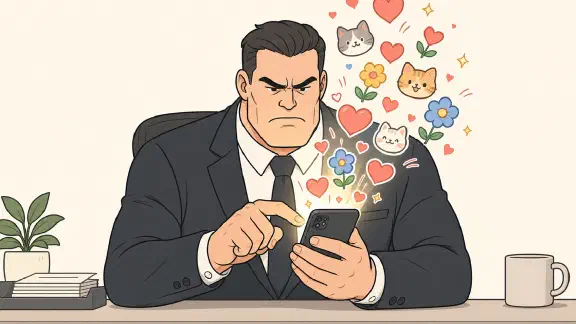
- Gap — the character who breaks their own type. An impression already built by appearance, rank, or usual manner, contradicted at exactly one point — the intimidating department head whose messages are full of emoji, or the towering, scowling character whose one soft spot is small animals. The setup is your own reputation, so it fires without you saying anything.
- Gyakuten — swap who outranks whom. Parent and child, staff and customer: take a hierarchy society has already fixed and reverse it, entirely straight-faced. A grade-schooler with folded arms: “Dad. One hour of phone a day.” No explanation needed, because the social norm does the setup for free.
Patterns of repetition
- Tendon — the delayed callback. Bring a line back after the room has half-forgotten it — usually a topic or two later. Too soon and it is just repetition; too late and nobody connects it. By one of several accounts, named after the tempura rice bowl, which carries two of the same shrimp. Low cost, high hit rate, which makes it one of the most practical patterns in ordinary conversation.
- Escalate — the same move, higher each time. Repeat an action while raising the magnitude on every pass: a single candy, then a box of sweets, then a sack of rice. The first two rounds teach the audience the rule; the third breaks the slope. Where tendon waits for the memory to half-fade, this one attacks while it is still fresh.
Patterns that borrow from the moment
- Trend — take what is already in the air. Pick up a phrase or an impression that is current right now. Mechanically the simplest pattern here, and the only one with an expiry date: past its season it does not merely stop working, it actively dates the speaker. Timing is the entire skill.
How to read these
Every pattern article on this site follows the same five parts:
- What it is — the structure itself.
- Why it works — the mechanism, and the cultural assumptions it relies on.
- Closest English equivalent — and how it differs.
- Examples — the pattern in the wild.
- How to use it — and where it fails.
The third section is the one to read first if you are coming from English-language comedy. Some of these patterns map onto something you already know, but never cleanly, and the gap is where the useful information is.
Tendon is close to the stand-up callback — but a callback usually returns to a bit from much earlier in a set, while tendon aims at a much narrower window: late enough that the room has half-forgotten, early enough that the recognition still fires. The Japanese term names the interval, not just the repetition, and that is the whole craft of it.
Gap looks like the “hidden depths” character turn — but in Japanese fiction the gap is often an initial condition of the character design rather than a revelation about them, which is why it can be deployed over and over without ever being spent.
And noritsukkomi has no clean English counterpart at all: the English-language double act splits the straight man and the funny man between two performers, and even solo comics who play both rarely do it as a single deliberate move — accept, commit, then reject — inside three seconds.
So the answer to “why is that funny” is rarely a fact about Japan. It is usually a structure — one of these nineteen — plus a shared expectation for the structure to bend. Once you have the names, you will start seeing them in the next episode you watch, and the half-second delay goes away.